There are some dishes in Greek cooking that remind me why simple food is often the best food.
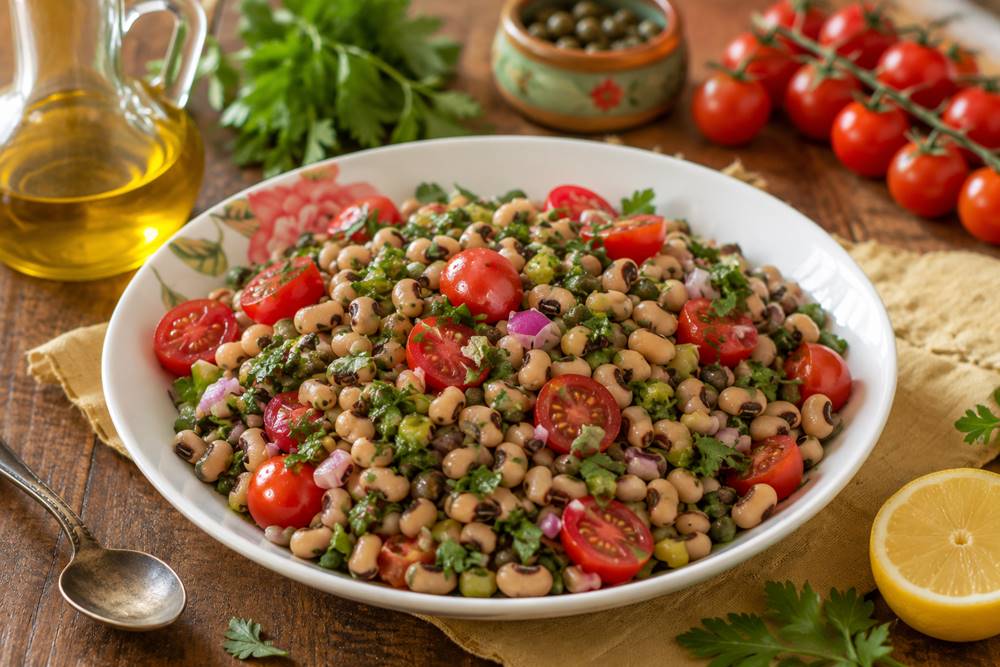
This Greek black-eyed pea salad, or mavromatika salata, is one of them. Tender black-eyed peas are combined with ripe tomatoes, crisp green pepper, red onion, capers and plenty of fresh parsley, then dressed simply with extra virgin olive oil and fresh lemon juice.
Nothing complicated. Nothing unnecessary.
And yet, when everything comes together, you have a wonderfully satisfying dish that can be served as a salad, a light lunch, a side dish or part of a Greek meze table.
Black-eyed peas (mavromatika fasolia in Greek) have long had a place in Greek home cooking. Like other pulses, they are valued because they are economical, nourishing and versatile. Greek culinary sources record black-eyed peas in salads as well as cooked dishes, often paired with seasonal vegetables, herbs, olive oil and an acidic element such as lemon or vinegar.
For me, this particular version is especially suited to the end of summer and the beginning of autumn. September still gives us beautiful ripe tomatoes and peppers, while legumes begin to bring a little more substance to the table.
It is exactly the kind of food I love: seasonal, colorful, unfussy and unmistakably Mediterranean.
Greek Black-Eyed Pea Salad Recipe (Serves 4)
Ingredients
- 250 g (8.8 oz) dried black-eyed peas
- 1 small red onion, finely chopped
- 2 medium ripe tomatoes, diced, or 10–12 cherry tomatoes, halved
- ½ green bell pepper, finely chopped
- 2 tbsp capers, drained
- ½ bunch fresh parsley, chopped
- 5 tbsp extra virgin olive oil
- 2–2½ tbsp fresh lemon juice
- Salt, to taste
- Freshly ground black pepper
Instructions
Rinse the black-eyed peas thoroughly and place them in a saucepan with plenty of cold water.
Bring to a boil and cook for about 5 minutes. Drain and discard this first cooking water.
Return the peas to the saucepan and cover them with fresh hot water. Simmer gently for approximately 20–30 minutes, or until tender but still holding their shape.
Be careful not to overcook them. For a good bean salad, we want individual, creamy beans — not a mash.
Drain well and allow them to cool until just warm or at room temperature.
Place the black-eyed peas in a large bowl and add the chopped tomatoes, red onion, green pepper, capers and parsley.
In a small bowl, whisk together the extra virgin olive oil, lemon juice, salt and black pepper.
Pour the dressing over the salad and toss gently.
Allow the salad to rest for 20–30 minutes before serving. This small step makes a noticeable difference: the beans absorb some of the lemon and olive oil while the vegetables and herbs perfume the entire salad.
Serve at room temperature.
Extra Tips
If your red onion is particularly strong, rub the chopped onion gently with a little salt, rinse it quickly under cold water and drain it thoroughly before adding it to the salad. It keeps its crunch but loses some of its sharpness.
Use ripe, flavorful tomatoes. This is not the recipe for pale winter tomatoes — the juice they release becomes part of the dressing.
Don’t cook the black-eyed peas until they split apart. Start checking them early because cooking time can vary considerably according to their age.
And use a good Greek extra virgin olive oil if you can. With so few ingredients, the quality of the olive oil really shows.
One more little secret: taste the salad again just before serving. Beans absorb seasoning as they rest, so it may need another squeeze of lemon or a pinch of salt.
What to Serve with Mavromatika Salata
I can happily eat a bowl of this salad with nothing more than warm crusty country bread and a few olives. But it also works beautifully as part of a larger Greek meal.
Serve it alongside grilled sardines, sea bream or another simply grilled fish. It also pairs nicely with grilled chicken, roasted vegetables or a selection of Greek meze.
For a completely plant-based meal, add bread, olives and perhaps some grilled vegetables.
For wine, I would choose a crisp, dry Greek white, such as Assyrtiko or Moschofilero. Their freshness works beautifully with the lemon, tomato and capers.
And for a relaxed Greek meze table? A small glass of tsipouro or ouzo works very nicely too.
Nutritional Value
Black-eyed peas are nutritionally much more interesting than their humble appearance suggests.
Cooked black-eyed peas provide plant protein, complex carbohydrates and dietary fiber, as well as folate, iron, magnesium, potassium and other micronutrients. Legumes are also naturally low in saturated fat.
Tomatoes and peppers add vitamin C and antioxidant compounds, while extra virgin olive oil supplies predominantly monounsaturated fat and bioactive compounds characteristic of the Mediterranean dietary pattern.
What Can This Salad Be Good For?
Because of its combination of fiber, plant protein and complex carbohydrates, black-eyed pea salad can contribute to satiety and can be a useful part of a balanced diet.
Regular consumption of legumes as part of an overall healthy dietary pattern is associated with cardiovascular and metabolic benefits. Importantly, though, no single recipe prevents or treats disease on its own — it is the overall dietary pattern that matters.
FAQ
- Do I need to soak black-eyed peas overnight?
Usually, no. Unlike chickpeas or many larger dried beans, black-eyed peas generally cook relatively quickly without overnight soaking.
- Why do you discard the first cooking water?
This is a traditional household technique often used with legumes. For this recipe, I find that the brief first boil followed by fresh water gives the beans a clean taste and allows me to control their final texture well.
- Can I use canned black-eyed peas?
Yes, when time is short. Drain and rinse them very well before using. However, for this simple salad I prefer dried black-eyed peas because I can control exactly how tender they become.
- Can I make the salad ahead?
Absolutely. You can prepare it several hours ahead and refrigerate it. Take it out a little before serving because its flavors and olive oil are at their best when the salad isn’t ice-cold.
- Lemon juice or vinegar?
Both appear naturally in Greek legume salads, but I prefer fresh lemon juice in this version. It gives the salad a bright, clean flavor that works particularly well with parsley and capers.
- Can I add feta?
Of course you can, but I wouldn’t for this recipe. The beauty of this salad is its simplicity, and leaving out the cheese also keeps it completely plant-based.
- How long does it keep?
Stored in an airtight container in the refrigerator, it is best eaten within about 2–3 days. The vegetables gradually soften, so I prefer it on the day it is made or the following day.
A Taste of the Greek September
This is one of those recipes that doesn’t need to impress with complicated techniques.
A pot of beans. A couple of ripe tomatoes. An onion, a pepper, some parsley and capers. Good olive oil and a lemon.
Put them together and you have a bowl filled with the colors and flavors of a Greek table at the end of summer.
And perhaps that is one of the most beautiful things about Greek cooking: when the ingredients are good, we don’t have to do very much to them.
Every Greek recipe tells a story. Discover authentic flavors, traditions, and timeless family recipes with CookTheGreekWay.