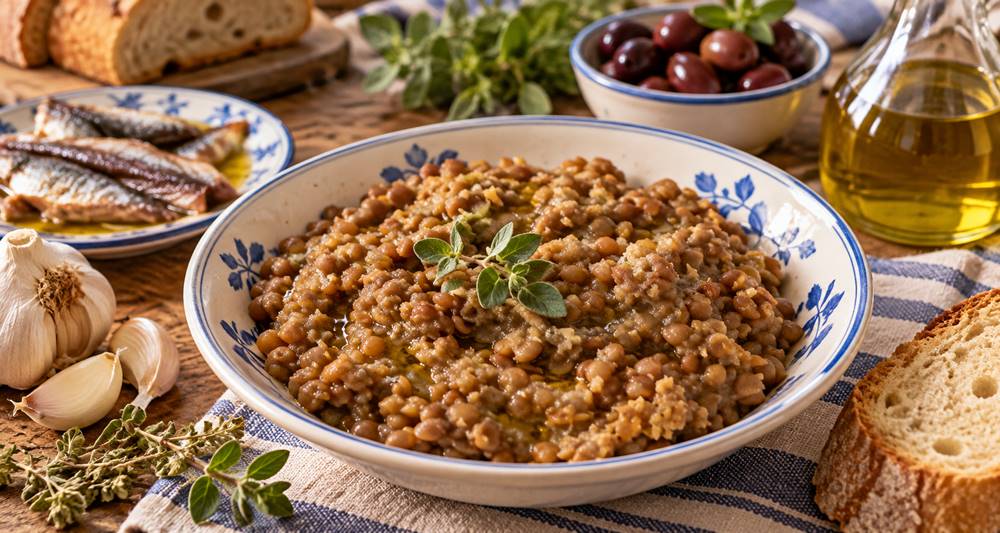
Some Greek recipes are memorable precisely because they contain so little. Eglouvi lentils, from the mountainous village of Eglouvi on Lefkada, are one of them.
Here there is no tomato, carrot or bay leaf. Lentils, garlic, good olive oil, oregano and a little vinegar are enough.
Eglouvi lies in the mountainous interior of Lefkada, and its lentils have become inseparable from the identity of the village. The local product, Faki Eglouvis, has Protected Designation of Origin status.
What fascinated me most, however, was the old cooking technique. The lentils are not simply boiled. Near the end of cooking they are “giachnizontai”: olive oil is added and some of the lentils are pressed against the side of the pot with a wooden spoon. This naturally thickens the dish without flour or any other thickener. A local account even describes the cooled lentils as becoming firm enough to be cut almost like a cream.
Having cooked them myself, I can confirm one important detail: do not judge their final consistency while they are hot. They thicken considerably as they cool.
Eglouvi Lentils from Lefkada – A Traditional Greek Recipe (Serves 4)
Ingredients
- 350 g Eglouvi lentils, or good-quality small brown lentils
- 4–5 garlic cloves
- 70–80 ml extra virgin olive oil
- 1 small sprig dried oregano
- Salt
- Red wine vinegar, for serving
- Hot water, as needed
Method
Sort through the lentils, rinse well and place them in a pot with enough cold water to cover. Bring to the boil and allow them to boil briefly two or three times. Drain.
Return the lentils to the pot with the garlic and enough fresh water to cover them. Cook gently until tender and most of the water has been absorbed.
Reduce the heat to very low. Add the olive oil and salt. Using a wooden spoon, stir continuously while pressing some of the lentils against the side of the pot. Continue this traditional giachnisma for about 10–15 minutes. The lentils should begin to break down and become naturally creamy while plenty of them remain whole. This technique is recorded in local descriptions of the Eglouvi preparation.
Gradually add about 250–400 ml hot water, according to the consistency you prefer, and simmer again.
Add the oregano during the final 10 minutes. Remove it before serving so that its flavour does not become bitter.
Serve warm with red wine vinegar added directly to each plate. The official Lefkada recipe likewise places the vinegar at serving rather than in the pot.
Tips
- Use small lentils if genuine Eglouvi lentils are unavailable; cooking time will vary, so watch the texture rather than the clock.
- Don’t mash everything. The beauty of the dish is the contrast between whole lentils and the creamy portion created by the wooden spoon.
- And don’t add too much water at the end. Once cooled, my lentils became beautifully thick — exactly the rustic texture this recipe is known for.
What to Serve with Eglouvi Lentils
Crusty country bread, olives and salted sardines make a wonderfully traditional table. In fact, at the annual lentil celebration at Agios Donatos, villagers traditionally cook large pots of Eglouvi lentils and serve them with olives and salted sardines.
For wine, I would choose a dry, fresh Greek white wine, whose acidity works well with the earthy lentils and vinegar.
If serving the salted sardines too, keep the wine crisp rather than heavy.
Nutrition & Health
Approximate nutrition per serving: about 470–490 kcal, 21–22 g protein, 55–60 g carbohydrates, 19–20 g fat and roughly 10–13 g fiber. Values vary with the lentils and amount of olive oil actually consumed.
Lentils are an excellent plant source of protein, fiber, folate, iron and potassium. Their combination of protein and fiber also makes them particularly satisfying.
Harvard’s Nutrition Source notes that lentils contain both soluble and insoluble fiber and are naturally low in saturated fat and sodium.
Their iron is non-heme iron, the plant form, so its absorption differs from iron from animal foods.
FAQ
- Do I need genuine Eglouvi lentils?
They are the authentic choice, but a good small, quick-cooking brown lentil can reproduce the method.
- Why are there no tomatoes or carrots?
Because this traditional Lefkada preparation is deliberately simple. The documented recipe centres on lentils, olive oil, garlic, oregano, salt and vinegar.
- Should the lentils be thick?
Yes. They become considerably thicker as they cool, so don’t expect the consistency of a conventional lentil soup.
- Can I add the vinegar while cooking?
Traditionally, it is added at the table, directly to the plate.
- Can I make them ahead?
Absolutely. Just remember that they will thicken in the refrigerator; loosen them gently with a little hot water when reheating.
Every Greek recipe tells a story. Discover authentic flavors, traditions, and timeless family recipes with CookTheGreekWay.



Leave a comment