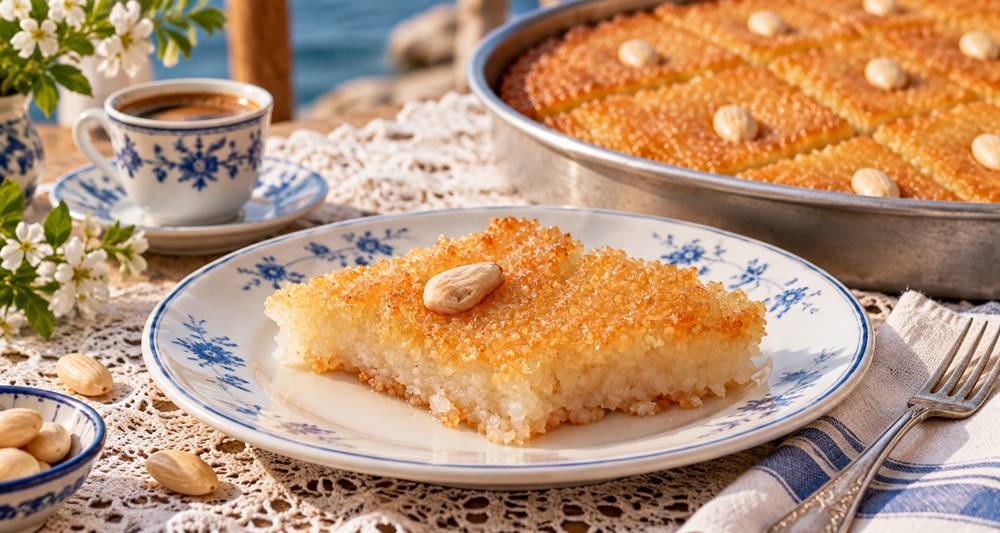
When most people hear the word ravani, they think of the familiar Greek semolina cake soaked in syrup. In the historic seaside town of Galaxidi, however, there is a very different version.
Galaxidi Rice Ravani, or Ravani Galaxidiotiko, is made from rice that is washed, dried and finely ground before being slowly cooked with water, sugar and olive oil. The thick mixture is then baked until a deep golden crust forms on top.
Rice ravani has a long connection with Galaxidi and its maritime history. Local accounts describe it as a sweet prepared for generations, traditionally in large pans and once baked in wood-fired ovens.
Its ingredients are wonderfully simple, but this is one of those recipes where technique matters more than complexity.
A Different Kind of Greek Ravani
Ingredients
- 500 g short-grain rice, preferably glacé rice
- 665–670 g granulated sugar
- About 1 liter water*
- 80 ml mild extra virgin olive oil, plus extra for the pan
- ½–1 teaspoon vanilla
- A pinch of salt
- Blanched whole almonds, for decorating
*After grinding the rice, measure its volume. Use approximately twice that volume of water.
How to Make Galaxidi Rice Ravani
Wash the rice thoroughly and drain it. Spread it over a clean kitchen towel and allow it to dry completely.
Once dry, grind it in a food processor. You want very fine grains rather than perfectly powdered rice flour.
Measure the ground rice by volume and prepare twice that amount of water.
Place the water and olive oil in a large, heavy-bottomed pot. Add the ground rice, sugar, vanilla and salt.
Bring the mixture gently to a boil, then reduce the heat to low. Cook for approximately 30 minutes, stirring regularly with a wooden spoon.
Do not rush this stage. The mixture will gradually become very thick. It is ready when it starts pulling cleanly away from the sides of the pot.
Generously oil a 26–28 cm baking pan. Transfer the mixture to the pan and smooth the surface with an oiled spoon or spatula.
Score the surface into diamond-shaped pieces and press one blanched almond into each diamond.
Bake in a preheated conventional oven at 180°C (356°F) for 60–70 minutes, preferably on a lower rack, until the surface develops a rich golden-brown crust.
Allow the ravani to cool completely before cutting.
The Most Important Baking Tip
- Do not judge this dessert only by how firm it feels while hot.
- Rice ravani continues to set considerably as it cools. Baking it much longer in search of an even darker crust can result in a dessert that becomes extremely firm once cold.
- In my own kitchen, I found that 60–70 minutes at 180°C gives the best balance: enough time for that characteristic golden crust without unnecessarily drying the interior.
- The same patience is important on the stovetop. About 30 minutes over low heat allows the rice mixture to cook properly and reach the stage where it naturally releases from the sides of the pot.
A Note on Spices
Some versions are finished with cinnamon or cloves, but they are not essential to Galaxidi Rice Ravani.
Local recipes also use whole almonds as decoration, giving us a beautifully simple version where the flavor of rice, olive oil and caramelized sugar remains at the forefront.
How to Serve It
Serve Galaxidi Rice Ravani at room temperature, cut along the pre-scored diamonds. It needs very little accompaniment — a cup of Greek coffee is perfect.
Its appeal lies in the contrast between the deeply golden baked surface and the dense, distinctive rice interior.
Nutrition
Rice provides carbohydrates and energy, while olive oil contributes mainly monounsaturated fats. Almonds add small amounts of protein, fiber and unsaturated fats.
Like most traditional sweets, however, rice ravani contains a substantial amount of added sugar and is best enjoyed in moderate portions as part of an overall balanced diet.
FAQ
- Is Galaxidi Rice Ravani the same as semolina ravani?
No. Despite sharing the name, the Galaxidi version is based on finely ground rice rather than semolina and uses a very different preparation method.
- Do I need rice flour?
Traditionally, the rice itself is washed, thoroughly dried and then ground.
- Why did my ravani become too hard?
The most likely reason is overbaking. Remember that it firms considerably while cooling.
- Can I omit cinnamon and cloves?
Yes. They are not necessary. Whole blanched almonds make an authentic and elegant finishing touch.
- When should I cut it?
Score it before baking, but wait until it has cooled completely before separating the portions.
Simple ingredients, patience and careful timing transform humble rice into one of Galaxidi’s most distinctive traditional sweets — a recipe that tells a very different story from the Greek ravani most of us know.
Every Greek recipe tells a story. Discover authentic flavors, traditions, and timeless family recipes with CookTheGreekWay.



Leave a comment