There comes a moment toward the end of every Greek summer when the fruit itself tells us that the season is beginning to change.
For me, figs are part of that moment.
Sweet, soft and warmed by the August sun, fresh figs have been treasured around the Mediterranean since antiquity. In Greece, the fig tree became part of both the landscape and everyday rural life, providing fruit that could be eaten fresh, dried in the sun or preserved for the months ahead.
And that is exactly what traditional home preserving was about: not allowing the abundance of summer to go to waste.
Greek households turned seasonal fruits into jams, spoon sweets and preserves that could fill the pantry long after the harvest had ended.
Fig jam is one of the simplest examples.
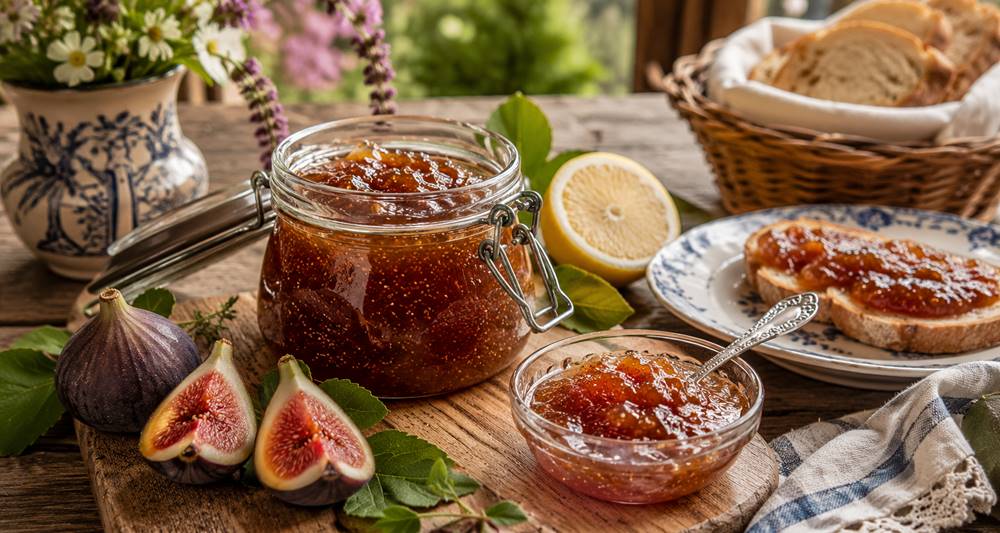
There is no need to complicate it. Beautiful ripe figs, sugar and lemon are enough.
Open a jar in winter and, somehow, August returns to the breakfast table.
Traditional Greek Fig Jam Recipe (Makes: approximately 3 medium jars)
Ingredients
- 1 kg ripe fresh figs
- 500–600 g granulated sugar
- Juice of 1 large lemon
- 2 tbsp water, only if needed at the beginning
Method
Wash the figs gently and dry them well.
Remove the hard stems. If the skins are tender and the figs are in excellent condition, there is no need to peel them.
Cut the figs into quarters and place them in a heavy-bottomed saucepan.
Add the sugar and gently mix. Leave the fruit for 1–2 hours, allowing the sugar to draw out its natural juices.
Place the saucepan over medium-low heat. If the figs have released very little liquid, add 1–2 tablespoons of water.
Once the mixture begins to simmer, reduce the heat.
Cook gently for approximately 35–45 minutes, stirring occasionally with a wooden spoon so the jam does not stick to the bottom.
As the figs soften, lightly crush some of them with the spoon. I like to leave a few small pieces intact because homemade fig jam should have character and texture.
During the final 5 minutes, add the fresh lemon juice.
When the jam has thickened, remove it from the heat.
While still hot, carefully transfer it into properly sterilized jars and follow a tested safe canning/preserving method if you intend to store the jars unrefrigerated. Otherwise, allow the jam to cool and keep it refrigerated.
How Do I Know When Fig Jam Is Ready?
Here is the old-fashioned cold plate test.
Before you start cooking, place a small plate in the refrigerator.
When you think the jam is ready, put a teaspoon of it onto the cold plate and wait about 30 seconds.
Push it gently with your finger.
If the surface wrinkles slightly and the jam does not immediately run back together, it is ready.
Remember that fig jam continues to thicken as it cools.
Tips for Perfect Fig Jam
- Choose ripe but healthy figs. They should be sweet and aromatic, without being fermented or damaged.
- Don’t automatically peel them. The skins contribute colour, flavour and texture.
- Use a wide saucepan. A larger surface allows excess moisture to evaporate more efficiently.
- Keep the heat gentle. High heat can catch the natural sugars at the bottom of the pan.
- Don’t overcook it. This is probably the most important secret. Overcooked fig jam becomes excessively thick and loses some of its fresh fruit character.
- Don’t skip the lemon. It balances the sweetness and acidity and helps the preserve set.
Let the figs speak for themselves. Cinnamon, vanilla, cloves and liqueurs can all create delicious variations, but for a simple traditional version I prefer just figs, sugar and lemon.
How to Eat Greek Fig Jam
Of course, the simplest way is also one of the best:
a thick slice of rustic bread with fig jam.
But there are many possibilities.
Try it:
- on toast or fresh country bread;
- spooned over Greek yogurt;
- with strained yogurt and walnuts;
- alongside aged Greek cheeses such as Graviera or Kefalotyri;
- with fresh Manouri or Anthotyro;
- on pancakes or waffles;
- with porridge or overnight oats;
- as a filling for cakes, biscuits and tarts;
- on a cheese board with walnuts and almonds.
One of my favourite combinations is fig jam, Greek yogurt and walnuts. Simple, Mediterranean and delicious.
And for an evening cheese board, pair fig jam with a mature Graviera and a glass of wine.
Approximate Nutritional Value
Per tablespoon (about 20 g):
- Calories: approximately 45–55 kcal
- Carbohydrates: 12–14 g
- Sugars: approximately 11–13 g
- Protein: less than 1 g
- Fat: negligible
- Fibre: approximately 0.5–1 g
Values vary according to the natural sweetness of the figs, the amount of sugar used and the final concentration of the jam.
Fresh figs naturally contain fibre, potassium and various plant compounds. However, traditional jam also contains a considerable amount of added sugar.
For that reason, I prefer to think of it exactly as our grandmothers did: a sweet preserve to be enjoyed in modest amounts, not something that needs a health claim to earn its place on the table.
FAQ
- Do I need to peel figs before making jam?
No. If the skins are tender and undamaged, you can leave them on. They add flavour, colour and texture.
- Which figs are best for fig jam?
Use ripe, naturally sweet figs that are still in good condition. Both green and dark varieties can make excellent jam.
- Why do we add lemon juice?
Lemon provides acidity, balances the sweetness and assists with the setting of the preserve.
- Can I reduce the sugar?
Yes, but significantly reducing sugar changes the texture, keeping quality and food-safety considerations. A reduced-sugar preserve should not automatically be treated as shelf-stable.
- Why is my fig jam too thick?
It was probably cooked for too long. Remember that the jam becomes noticeably thicker after cooling.
- How should homemade fig jam be stored?
For refrigerated jam, use clean sterilized jars and keep them chilled. For long-term room-temperature storage, use a validated home-canning procedure appropriate for fruit preserves rather than relying only on hot filling or turning jars upside down.
- Can I add spices?
Certainly. Cinnamon, cloves or vanilla can be used for variations, but I prefer the basic version when I want the flavour of ripe summer figs to dominate.
Keeping a Little Greek Summer in a Jar
Perhaps this is what I love most about homemade preserves.
They were born from practicality, but they became part of our food memories.
At the end of summer, when the fig trees were heavy with fruit, preserving meant that nothing valuable was wasted. A few jars stored away could bring that flavour back to the family table months later.
And when I open a jar of homemade fig jam, spread it generously over a slice of bread and taste that unmistakable sweetness, I don’t simply taste figs.
I taste the last days of a Greek summer.
Every Greek recipe tells a story. Discover authentic flavors, traditions, and timeless family recipes with CookTheGreekWay.