A Traditional Greek Summer Recipe from the Heart of Mani
Sometimes, the greatest recipes are the simplest.
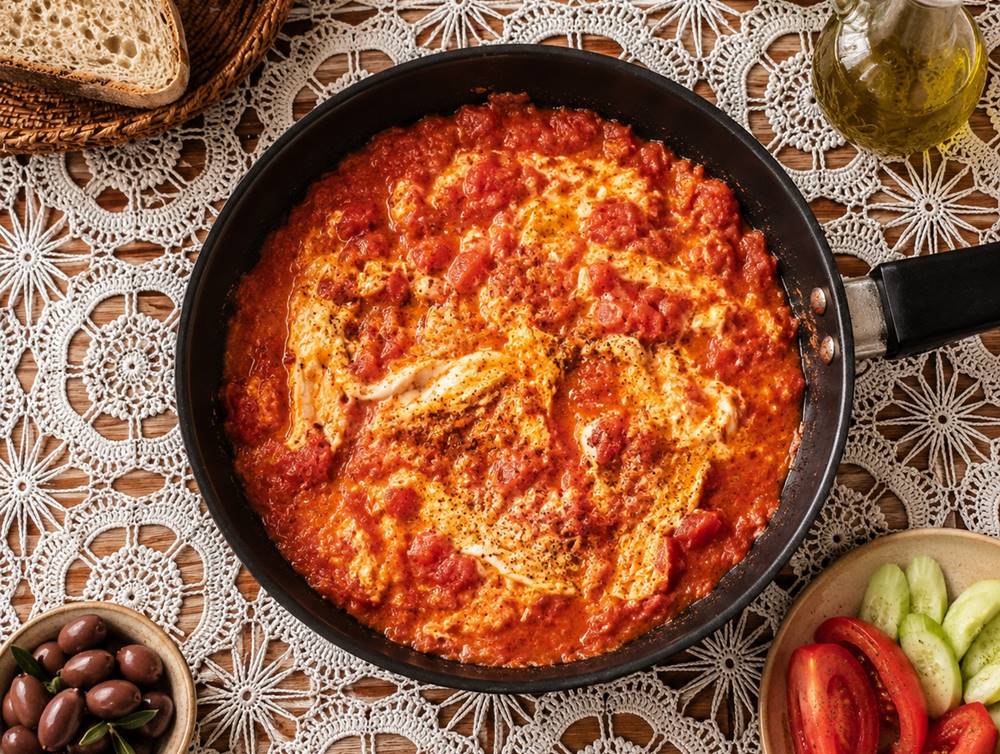
Kagianas, also known throughout Greece as Strapatsada, is one of the oldest and most beloved dishes of the Greek countryside.
In Mani, however, this humble recipe reached perfection.
Prepared only during the height of summer, when tomatoes were overflowing in village gardens, Kagianas was never considered a “poor man’s meal.”
It was a celebration of the season itself.
Sweet ripe tomatoes.
Fresh village eggs.
Exceptional extra virgin olive oil.
Nothing more.
Nothing less.
A Taste of Mani
Throughout the Mani Peninsula, families waited patiently for August tomatoes.
Only then would Kagianas appear on the table.
Women peeled the tomatoes by hand, diced them with a knife, and slowly cooked them until they became thick, rich and naturally sweet.
Eggs were added only at the very end.
Served with fresh country bread, olives and cool well water, Kagianas represented the very essence of Greek summer.
As many Maniot grandmothers would say:
“The tomato does the talking.”
Kagianas or Strapatsada?
Although the names are often used interchangeably, Kagianas is the traditional Maniot name for the dish.
Across other regions of Greece it is better known as Strapatsada.
The basic ingredients remain the same—ripe tomatoes, eggs and olive oil—but each region proudly adds its own local touch.
In Mani, however, simplicity is everything.
Authentic Mani Kagianas
Serves 2–3
Ingredients
- 5 large ripe summer tomatoes
- 4 fresh eggs
- 70–80 ml extra virgin olive oil
- Salt
- Freshly ground black pepper
Nothing else.
That is its beauty.
Instructions
Prepare the Tomatoes
Peel the tomatoes.
Instead of grating them, cut them into small cubes with a knife.
This traditional technique allows the tomatoes to keep both their texture and natural sweetness.
Cook the Sauce
Heat the olive oil in a wide pan.
Add the tomatoes.
Cook slowly over medium-low heat for 20–30 minutes.
The tomatoes should:
- Lose most of their liquid
- Become rich and concentrated
- Develop a jam-like consistency
This is the secret that transforms Kagianas from ordinary to unforgettable.
Add the Eggs
Beat the eggs only lightly.
Simply break the yolks.
Do not whisk them until frothy.
Pour them over the tomatoes.
Using a wooden spoon, stir gently and slowly.
The goal is to create large, creamy ribbons of egg—not tiny scrambled pieces.
Season with salt only at this stage.
Finish with freshly ground black pepper.
Grandmother’s Secrets
- Never grate the tomatoes.
- Always use ripe summer tomatoes.
- Add salt only after the tomatoes have reduced.
- Use generous amounts of extra virgin olive oil.
- Never overcook the eggs.
Creamy eggs are the hallmark of authentic Kagianas.
Regional Variations
Messenian Version
Just before removing the pan from the heat, pieces of Sfela cheese are added.
The cheese softens without completely melting, creating a wonderfully rich texture.
Cretan Version
In Crete, diced Apaki (traditional smoked pork) is sautéed first before the tomatoes are added.
The result is a richer version, often served for Sunday breakfast.
Extra Cooking Tips
- Choose tomatoes that are fully ripe and naturally sweet.
- A wide pan helps excess moisture evaporate faster.
- Stir the eggs gently to keep large, silky curds.
- Serve immediately while still creamy.
- Finish with a drizzle of fresh olive oil before serving.
What to Serve with Kagianas
Traditionally, Kagianas is served with the simplest accompaniments.
Perfect Pairings
- Rustic country bread
- Kalamata olives
- Fresh cucumber
- Greek feta cheese
- Village salad (Horiatiki)
Best Wine Pairings
Because of its fresh tomato flavor and rich olive oil, Kagianas pairs beautifully with light Mediterranean wines.
White Wines
- Moschofilero
- Assyrtiko
- Savatiano
Rosé
A dry Greek rosé makes an excellent summer companion.
Non-Alcoholic Pairings
- Fresh orange juice
- Homemade lemonade
- Sparkling water
- Greek mountain tea
Nutritional Value
Kagianas is naturally rich in high-quality protein, healthy fats and antioxidants.
Eggs provide complete protein, vitamin D, vitamin B12 and choline, while tomatoes are an excellent source of lycopene, vitamin C and potassium.
Extra virgin olive oil contributes heart-healthy monounsaturated fats and powerful polyphenols.
Health Benefits
As part of the Mediterranean diet, Kagianas offers numerous nutritional benefits:
- Excellent source of complete protein
- Rich in lycopene for antioxidant protection
- Supports heart health thanks to olive oil
- High in vitamin C and potassium
- Contains choline for brain health
- Naturally gluten-free
- Rich in healthy Mediterranean fats
Frequently Asked Questions (FAQ)
- What’s the difference between Kagianas and Strapatsada?
They are essentially the same traditional dish.
Kagianas is the Maniot name, while Strapatsada is more commonly used throughout the rest of Greece.
- Can I use canned tomatoes?
Fresh summer tomatoes are strongly recommended.
Their sweetness is what defines authentic Kagianas.
- Why shouldn’t the tomatoes be grated?
Diced tomatoes keep more texture and develop a richer, sweeter sauce during slow cooking.
- Why is the salt added at the end?
Traditional Maniot cooks believed that salting too early caused the tomatoes to release water too quickly, preventing their natural sweetness from fully developing.
- Can I add herbs?
Authentic Mani Kagianas contains no oregano, basil or paprika.
Its beauty lies in its remarkable simplicity.
A Celebration of the Greek Summer
Kagianas reminds us that authentic Greek cooking has never depended on complicated recipes.
It depends on patience.
On sun-ripened tomatoes.
On exceptional olive oil.
And on sharing simple food with family around the table.
One pan.
Three ingredients.
A lifetime of memories.
Every Greek recipe tells a story. Discover authentic flavors, traditions, and timeless family recipes with CookTheGreekWay.