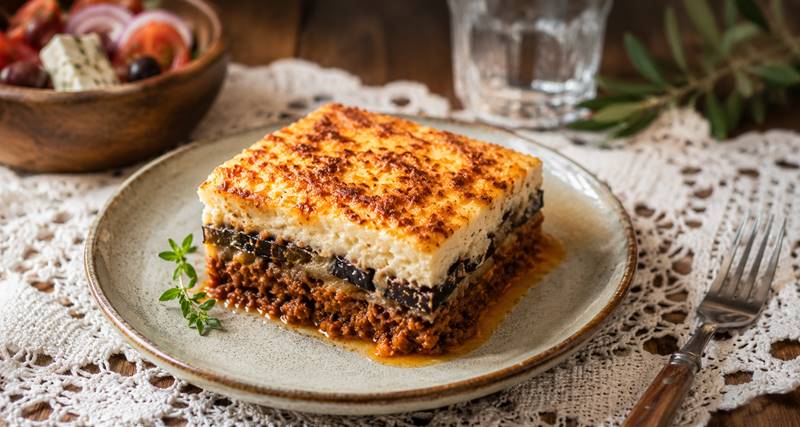
Few dishes represent Greece as beautifully as Moussaka. Rich, comforting, and deeply aromatic, it is the centerpiece of countless Sunday family gatherings and festive celebrations. Its unmistakable aroma of roasted eggplants, slow-cooked meat sauce, and creamy béchamel instantly brings back memories of home for Greeks around the world.
Although many modern recipes include potatoes or zucchini, the oldest family recipes from many Greek households were made exclusively with eggplants. Potatoes became popular later, mainly to make the baking dish larger and feed bigger families.
As many Greek grandmothers used to say:
“A truly good moussaka should smell like eggplants.”
A Brief History of Greek Moussaka
The word moussaka originates from the Ottoman culinary tradition. However, the layered version we know today—with eggplants, seasoned ground meat, and creamy béchamel—is a creation of early 20th-century Greek cuisine.
Influenced by French cooking techniques while preserving Mediterranean flavors, Greek moussaka gradually became one of the country’s signature dishes and remains one of the world’s best-known Greek recipes.
Traditional Greek Eggplant Moussaka
Serves 8–10
Ingredients
For the Eggplants
- 6 large globe eggplants
- Olive oil for light frying
- Salt
For the Meat Sauce
- 800 g (1¾ lb) lean ground beef
- 2 large onions, finely chopped
- 3 garlic cloves, minced
- 5 ripe tomatoes, grated
- 2 tbsp tomato paste
- 150 ml extra virgin olive oil
- 100 ml dry white or red wine
- 1 cinnamon stick
- 2 bay leaves
- A pinch of allspice
- Salt
- Freshly ground black pepper
For the Traditional Béchamel Sauce
- 1 litre whole milk
- 100 g butter
- 100 g all-purpose flour
- 2 eggs
- Freshly grated nutmeg
- Salt
- Black pepper
- 100 g grated Kefalotyri cheese (or Parmesan if unavailable)
Instructions
Prepare the Eggplants
Slice the eggplants into approximately 8–10 mm (⅜ inch) thick slices.
Sprinkle generously with salt and let them rest for 30–40 minutes.
Pat them dry thoroughly.
Lightly fry them in olive oil until they soften and develop a light golden color.
They should not become crispy—they will continue cooking inside the moussaka.
Transfer them onto a clean cotton kitchen towel for about 10–15 minutes to absorb excess oil without drying them out.
Prepare the Meat Sauce
Heat the olive oil and sauté the onions until translucent.
Add the garlic and then the ground beef.
Cook until browned.
Pour in the wine and allow the alcohol to evaporate.
Add the grated tomatoes, tomato paste, cinnamon stick, bay leaves, allspice, salt, and pepper.
Simmer over low heat for 45 minutes, until the sauce becomes thick and rich.
Prepare the Béchamel
Melt the butter.
Whisk in the flour.
Gradually add the warm milk while whisking continuously until smooth.
Remove from the heat.
Add the eggs, grated cheese, nutmeg, salt, and pepper.
Mix until silky and creamy.
Assemble the Moussaka
Layer in this order:
First layer of eggplants
Entire meat sauce
Second layer of eggplants
Béchamel sauce
Extra grated Kefalotyri on top
Bake at 180°C (350°F) for 50–60 minutes, until beautifully golden brown.
Allow the moussaka to rest for at least 30 minutes before serving.
The Seven Secrets of Every Greek Grandmother’s Perfect Moussaka
- Choose the right eggplants
Select eggplants that are shiny, firm, heavy for their size, and have very few seeds.
- Never over-fry them
The eggplants should soften and lightly caramelize—but never become crispy.
- Let them rest on a cotton towel
Instead of using only paper towels, old Greek cooks spread the fried eggplants on clean cotton towels to remove excess oil while preserving their delicate texture.
- Keep the meat sauce thick
A watery filling will make the layers collapse.
The sauce should be rich, concentrated, and almost dry.
- Use freshly grated Kefalotyri
Traditional Greek Kefalotyri adds the distinctive savory flavor and creates the beautiful golden crust.
- Let the moussaka rest
Waiting at least 30–40 minutes before slicing allows the layers to set perfectly.
- It tastes even better the next day
Many Greek families agree that reheated moussaka develops even deeper flavors.
Extra Cooking Tips
- Salt the eggplants before cooking to remove excess moisture and bitterness.
- Slice them evenly (about 8–10 mm thick) for uniform cooking.
- Don’t rush the meat sauce—slow cooking develops deeper flavor.
- Resting the finished moussaka is just as important as baking it.
- Pair it with a traditional Greek salad and crusty country bread for a complete Mediterranean meal.
- For dessert, serve chilled rice pudding (rizogalo) or fresh watermelon, just like many Greek families do during the summer.
What to Serve with Greek Moussaka
A traditional Greek moussaka is a complete and satisfying meal on its own, but the right side dishes and drinks can elevate the dining experience and create an authentic Mediterranean table.
Best Side Dishes
- Greek Village Salad (Horiatiki)
The freshness of ripe tomatoes, cucumbers, red onion, Kalamata olives, and creamy feta perfectly balances the richness of the moussaka.
- Crisp Green Salad
A simple salad with lettuce, arugula, spring onions, fresh herbs, and a light lemon-olive oil dressing adds brightness and freshness to every bite.
- Crusty Country Bread
Fresh rustic bread is ideal for soaking up every bit of the rich tomato meat sauce and creamy béchamel.
- Homemade Tzatziki
A bowl of cool, creamy tzatziki made with Greek yogurt, cucumber, garlic, and dill offers a refreshing contrast to the warm casserole.
- Marinated Olives & Pickled Vegetables
A small appetizer of Greek olives, pickled peppers, or caper leaves adds a pleasant salty and tangy touch to the meal.
Best Wine Pairings
Because moussaka combines roasted eggplants, slow-cooked beef, warm spices, and creamy béchamel, it pairs beautifully with medium to full-bodied wines.
- Red Wines
Agiorgitiko (Nemea)
Xinomavro
Merlot
Syrah
Cabernet Sauvignon
Their fruit-forward character and soft tannins complement the cinnamon-spiced meat sauce without overpowering the dish.
- White Wines
If you prefer white wine, choose rich and aromatic varieties such as:
Assyrtiko
Vidiano
Chardonnay (lightly oaked)
Their acidity cuts through the richness of the béchamel beautifully.
- Beer
A crisp Mediterranean lager or a light amber ale also pairs surprisingly well with traditional moussaka.
- Non-Alcoholic Pairings
For a refreshing alcohol-free option, serve:
Sparkling water with fresh lemon
Homemade lemonade
Iced mountain tea
Fresh pomegranate juice
Chilled sparkling mineral water with mint
Finish the Meal the Greek Way
Greek hospitality always ends on a sweet note.
Traditional desserts that pair perfectly with moussaka include:
Homemade Rice Pudding (Rizogalo)
Fresh Watermelon (especially during summer) or Watermelon pie (karpouzenia)
Greek Yogurt with Honey and Walnuts
Orange Cake (Portokalopita)
Walnut Cake (Karidopita)
Chef’s Tip
For the ultimate authentic Greek Sunday lunch, serve your moussaka with a fresh Greek village salad, warm crusty bread, a glass of Agiorgitiko red wine, and finish the meal with chilled rice pudding or sweet summer watermelon.
Simple, seasonal, and generous—that is the essence of Greek hospitality.
Nutritional Value
Eggplants are naturally low in calories and rich in dietary fiber, antioxidants, potassium, and vitamins.
Lean beef provides high-quality protein, iron, zinc, and vitamin B12.
Milk, butter, and cheese contribute calcium and protein, making moussaka a wholesome and satisfying family meal.
Health Benefits
When enjoyed as part of a balanced Mediterranean diet, moussaka provides many valuable nutrients:
Rich in high-quality protein
Excellent source of iron and vitamin B12
High in calcium for healthy bones
Provides antioxidants from eggplants and tomatoes
Dietary fiber supports healthy digestion
Helps promote satiety and long-lasting energy
Frequently Asked Questions (FAQ)
- Can I bake the eggplants instead of frying them?
Yes. Baking is a lighter option, while light frying delivers the most authentic traditional flavor.
- Why do you salt the eggplants first?
Salting removes excess moisture and reduces any bitterness, resulting in a better texture.
- Can I prepare moussaka in advance?
Absolutely. Many people believe it tastes even better the following day after the flavors have fully developed.
- How long should I let it rest before serving?
At least 30 minutes, allowing the layers to firm up and slice beautifully.
- What cheese is traditionally used?
Kefalotyri is the authentic Greek choice, although Parmesan can be used outside Greece.
A final note
In Greece, moussaka is more than a recipe—it is a symbol of hospitality, family gatherings, and Sunday lunches shared around a table. Every household has its own treasured version, passed down from one generation to the next, carrying memories as rich as its flavors.
Because the best recipes are not only cooked—they are remembered.