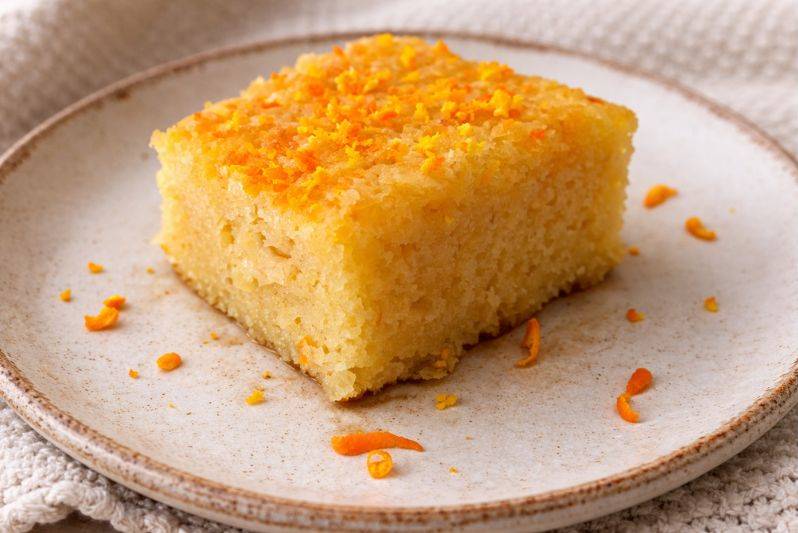
There are many versions of orange cake.
However, the most traditional Greek version, the one considered truly old and authentic, is the orange cake made with phyllo pastry, strained yogurt and orange syrup.
Light, moist and aromatic, without custard, with a gentle syrup that soaks the cake without making it heavy.
A dessert that doesn’t shout — it wins you over quietly.
The traditional orange cake originated in Central Greece (Roumeli) and Thessaly, and from there spread throughout the country.
And yet… these regions did not have orange groves, except for a few rare areas in southern Fthiotida and some lowland parts of Magnesia.
Oranges were an imported product.
From the late 19th century and especially after 1920–1930, oranges from Argos, Arta, Laconia and Chios traveled north to Roumeli and Thessaly by caravans, trains and small boats.
They were a festive ingredient, not an everyday one.
That’s why:
- there was no “everyday orange cake”
- it was prepared only for special occasions
The modern version of orange cake — with:
- yogurt
- crumbled phyllo pastry
- baking powder
- syrup made with fresh orange juice
appears in household notebooks after 1950–1960.
Why then?
Because:
- ready-made phyllo pastry became available
- baking powder entered home kitchens
- oranges were now accessible nationwide through trade
The earliest written records appear in cities such as: Lamia, Volos, Kalampaka, Agrinio and Larissa — not in mountain villages.
From these urban centers, the orange cake later spread to rural areas as a “modern” dessert.
The orange cake comes from Roumeli–Thessaly not because they had oranges,
but because:
- oranges arrived later through trade
- they were mainly used as an aroma
- the recipe is relatively recent (post-war)
- local pie-based desserts easily embraced orange flavor
Traditional Orange Cake – Authentic Recipe
Ingredients
For the Cake
- 1 package phyllo pastry
- 1 cup (200 ml) sunflower oil or light olive oil
- 1 cup sugar
- 1 cup strained Greek yogurt
- 3 eggs
- 1 sachet baking powder
- Zest of 2 large oranges
- Juice of 3 large oranges
- 2–3 tbsp cognac
- (optional) 1 sachet vanilla
For the Syrup
- 1½ cups sugar
- 1½ cups water
- 1 cup orange juice
- Orange peel
Instructions
- Dry the Phyllo
Traditional secret: orange cake succeeds only with completely dry, crumbled phyllo.
Air-drying method:
Spread the phyllo sheets on the counter and let them dry. Crumple them by hand.
Oven method:
Cut into large pieces and place in a warm oven until crisp.
- Prepare the Batter
Beat the oil and sugar
Add eggs, yogurt, cognac, orange zest, orange juice and vanilla
Mix in the baking powder
Crumble the dried phyllo and fold it into the mixture
- Baking
Bake at 180°C (350°F), fan-assisted, for 40–50 minutes, until nicely golden.
Tip: Press the center — if it feels firm, it’s ready.
- Syrup
Boil all syrup ingredients together for 6–7 minutes.
The syrup should be hot, and the cake cold or lukewarm.
Pour slowly, allowing it to absorb evenly.
Serving
Sprinkle with extra orange zest.
Orange cake tastes even better the next day!
Extra Success Tips
- Never skip drying the phyllo
- Keep the syrup light — orange aroma is the goal
- Do not cut the cake while hot
- For stronger aroma, add a little zest to the syrup as well
Nutritional Value (Indicative)
Orange cake:
- provides vitamin C from fresh oranges
- offers energy from carbohydrates and fats
- yogurt contributes protein and calcium
Best enjoyed as a festive dessert, in moderate portions.
FAQ – Frequently Asked Questions
- Can I make it without cognac?
Yes, but cognac is part of the traditional flavor profile.
- Why crumbled phyllo instead of layered?
So it absorbs the batter and syrup evenly.
- Should it be refrigerated?
Yes, for up to 4–5 days, well covered.
- Can I prepare it a day ahead?
Not only can you — that’s when it’s best.


 CookTheGreekWay