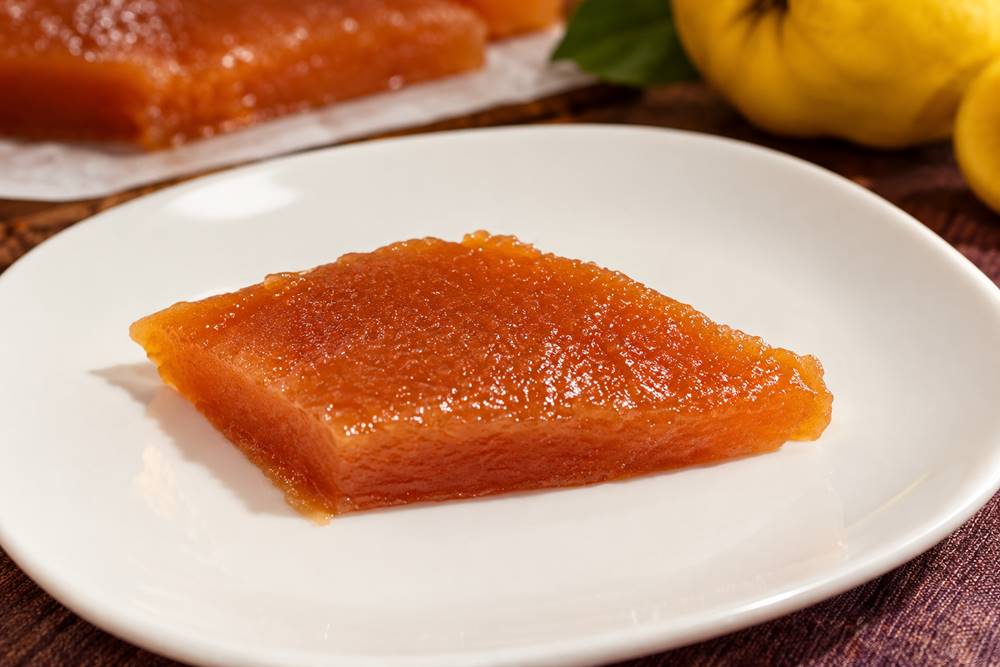
Autumn in Greece brings one of my favorite seasonal fruits: the fragrant, golden quince.
One of the most delicious ways to preserve its wonderful flavor is to prepare Kydonopasto, a traditional Greek quince paste made with just three simple ingredients: quince, sugar and lemon.
This old-fashioned sweet has a beautiful amber-to-reddish color, a firm texture and an intensely fruity taste.
I recently made it at home, and the result was absolutely wonderful! However, I discovered that patience is the real secret to achieving the perfect consistency.
A Traditional Greek Autumn Sweet
Quinces have been enjoyed in Greece since antiquity. Their fragrance and distinctive flavor have made them popular in traditional preserves, spoon sweets and homemade desserts.
Kydonopasto belongs to the family of firm fruit pastes, similar to Spanish membrillo.
Quinces naturally contain pectin, which helps the mixture set without gelatin.
Traditional Greek Kydonopasto Recipe
Ingredients
- 1.5 kg whole quinces
- Granulated sugar, equal to 80% of the weight of the cooked, drained quince purée
- 2 tbsp fresh lemon juice
- Water for the initial cooking
Example: For 1,000 g of cooked quince purée, use 800 g sugar.
Instructions
- Prepare the quinces
Wash the quinces thoroughly, removing their natural fuzz.
Cut into quarters and remove the seeds and hard cores. Keep the healthy skins, as they contain natural pectin.
- Cook until tender
Place the quince pieces in a saucepan and add just enough water to cover them.
Simmer for approximately 25–35 minutes, until completely tender.
Drain thoroughly, allowing as much excess water as possible to escape.
- Prepare the purée
Blend the cooked quinces until smooth.
Weigh the purée and calculate the sugar.
- Cook the quince paste
Transfer the purée to a wide, heavy-bottomed saucepan. Add the sugar and lemon juice.
Do not add extra water unless absolutely necessary to prevent scorching at the beginning.
Cook over low to medium-low heat, stirring frequently at first and almost continuously as the mixture thickens.
My experience: The stirring and evaporation stage required at least 70 minutes.
The mixture gradually becomes darker, thicker and more concentrated.
It is ready when a spatula leaves a clear trail across the bottom of the saucepan and the paste holds its shape instead of spreading.
Be careful: thick fruit paste can bubble and splash while cooking.
- Transfer to a baking dish
Line a small baking dish, approximately 20 × 20 cm, with parchment paper.
Spread the hot paste evenly, approximately 2 cm thick.
Allow it to cool completely.
- Let it dry naturally
Leave the paste to dry in a cool, clean, well-protected place.
In my kitchen, it needed up to three days before becoming firm enough to cut neatly into pieces.
Drying time depends on thickness, humidity and how much moisture remains after cooking. Refrigerate during drying if room conditions are warm or humid.
- Slice and refrigerate
Once firm, cut into squares or diamonds.
Store in an airtight container in the refrigerator, separating the pieces with parchment paper.
The paste may continue to become firmer as moisture gradually redistributes and evaporates when exposed to air.
Tips for Perfect Greek Quince Paste
- Drain the cooked fruit thoroughly.
Excess water makes setting more difficult. - Avoid adding water to the purée.
The sugar and fruit contain enough moisture for cooking. - Use a wide saucepan.
It helps moisture evaporate more efficiently. - Be patient.
My quince paste required at least 70 minutes of stirring. - Allow enough drying time.
It may take three days before the paste can be sliced. - Don’t judge it by color alone.
The final shade varies depending on the quinces and cooking conditions.
How to Serve Kydonopasto
I love enjoying quince paste with Greek graviera, aged kasseri or another firm, slightly salty cheese.
It also pairs beautifully with toasted almonds and a small glass of sweet Samos Muscat wine.
Serve it as an elegant dessert or as part of a Mediterranean cheese platter.
Nutritional Value and Health Benefits
Approximate nutrition per 30 g piece:
- Calories: 70–85 kcal
- Carbohydrates: 18–21 g
- Sugars: 16–19 g
- Fat: Less than 0.5 g
- Protein: Less than 0.5 g
- Fibre: Approximately 0.5–1 g
Values depend on the final yield and moisture content.
Quinces naturally provide fibre and plant compounds, including polyphenols. However, because Kydonopasto contains considerable added sugar, it is best enjoyed in small portions as an occasional sweet treat.
Frequently Asked Questions
- Does Kydonopasto need gelatin?
No. Quinces contain natural pectin, which helps the paste become firm.
- Why is my quince paste too soft?
It may contain too much moisture or need additional cooking and drying time.
- How long should I stir it?
My batch required at least 70 minutes during the final cooking stage. Larger or wetter batches may take longer.
- How long does it take to dry?
Allow up to three days, depending on the thickness and humidity.
- Should I refrigerate homemade quince paste?
Yes. I recommend storing this homemade version in the refrigerator rather than assuming it is shelf-stable.
A Sweet Taste of Greek Tradition
Making Kydonopasto takes time, but the result is worth every minute.
With only quince, sugar and lemon, this traditional Greek sweet captures the wonderful fragrance of autumn in every bite.
Every Greek recipe tells a story. Discover authentic flavors, traditions, and timeless family recipes with CookTheGreekWay.



Leave a Reply