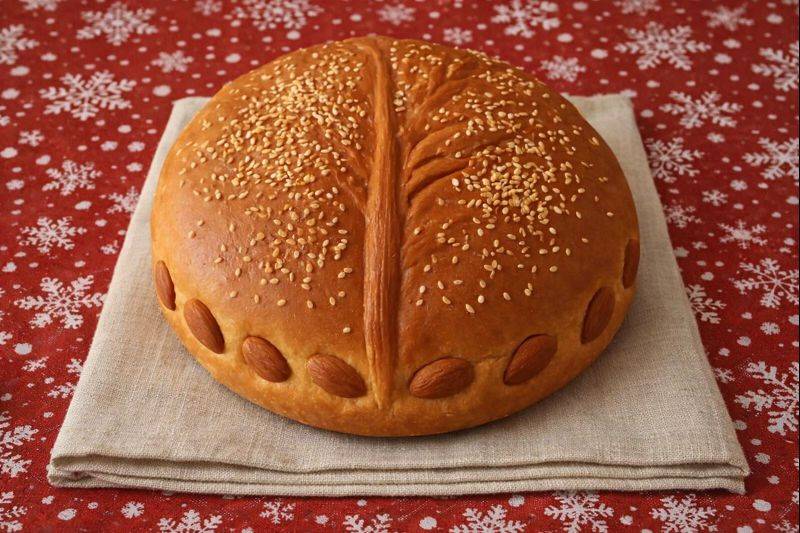
The bread made with blessing, love, and tradition.
Christ Bread, known as Christopsomo, is one of the holiest and most symbolic breads of Macedonian tradition. It is not just a festive loaf — it is a vow, a blessing, a family symbol, and an offering for the birth of Christ.
In the villages of Western and Central Macedonia, it was prepared with patience and crossed hands. Women would stay silent while the dough was rising — so the new year would be peaceful and blessed.
Christopsomo is never cut with a knife. It is broken by hand, just like people once broke bread in old times — “so the blessing is not hurt.”
The decoration in the center — a cross or a wheat stalk — symbolizes Christ and the blessing of the earth. Walnuts, almonds, or pomegranate seeds represent abundance and good fortune.
Ingredients
For the dough:
- 1 kg strong/bread flour
- 1 packet (or 25 g) fresh yeast
- 1½ cups lukewarm water or milk
- 1 tsp salt
- 2 tbsp honey
- 3 tbsp olive oil or melted butter
- ½ tsp cinnamon
- ½ tsp anise seeds (optional)
- 1 egg (optional, for a more festive texture)
For the decoration:
- Whole walnuts
- Almonds
- Sesame seeds
A small piece of dough for shaping the cross or wheat motif
Instructions
Start with a blessing — just like in the old days:
“In the name of Christ and the Virgin Mary, may our dough be blessed.”
Dissolve the yeast in lukewarm water with the honey and let it activate for 10 minutes.
In a large bowl, add the flour, salt, cinnamon, and anise.
Make a well and pour in the yeast mixture, oil, and egg.
Knead until the dough becomes soft and elastic.
Cover with a clean towel and let rise for 1–1½ hours until doubled.
Knead lightly again and shape into a round loaf.
Place on a baking tray lined with parchment paper.
Decoration
- Shape a small dough cross and place it in the center.
- Press almonds or walnuts around the loaf.
- Form a wheat stalk using thin dough strips.
- Brush the surface with honey diluted in water or beaten egg.
- Sprinkle with sesame seeds.
Bake at 180°C (350°F) for 45–50 minutes, until it turns a deep golden color.
Let it cool slightly and cover with a towel — to “keep its blessing,” as they used to say.
How They Blessed It in the Old Days
On Christmas Eve, the housewife would incense the bread three times:
“May we eat Christ’s bread, and may the Son of the Virgin Mary enlighten us.”
On Christmas morning, the head of the household broke the loaf by hand, saying:
“Christ is born — glorify Him.”
Little Secrets
- For a sweeter bread: Add 1–2 tbsp raisins or a little chopped walnut to the dough.
- For a fasting (vegan) version: Use water instead of milk and skip the egg.
In Florina, they flavor the dough with water in which anise seeds have been boiled — it makes the bread smell “like Christmas.”
Nutritional Value (per 100 g, approx.)
Calories: 260 kcal
Carbohydrates: 45 g
Protein: 7 g
Fat: 5 g
Fiber: 2 g
Sugars: 4–6 g (from the honey)
Christopsomo, although festive, is still a nourishing bread thanks to the flour, honey, olive oil, and nuts that contribute healthy fats and minerals.
FAQ – Frequently Asked Questions
- Can I make Christopsomo a day ahead?
Absolutely! It keeps beautifully. Wrap it in a clean towel and then in a bag.
- How do I warm it up without drying it out?
Place it in the oven at 100°C (210°F) for 10 minutes with a small bowl of water.
- Can I replace yeast with sourdough starter?
Yes — but it will need double the rising time and about 200 g active starter.
- What does the wheat motif symbolize?
The blessing of the earth, the abundance of the year, and the bread Christ gives to people.
- Can I make it without cinnamon or anise?
Of course — both are optional and you can keep the flavor more neutral if you prefer.

 CookTheGreekWay