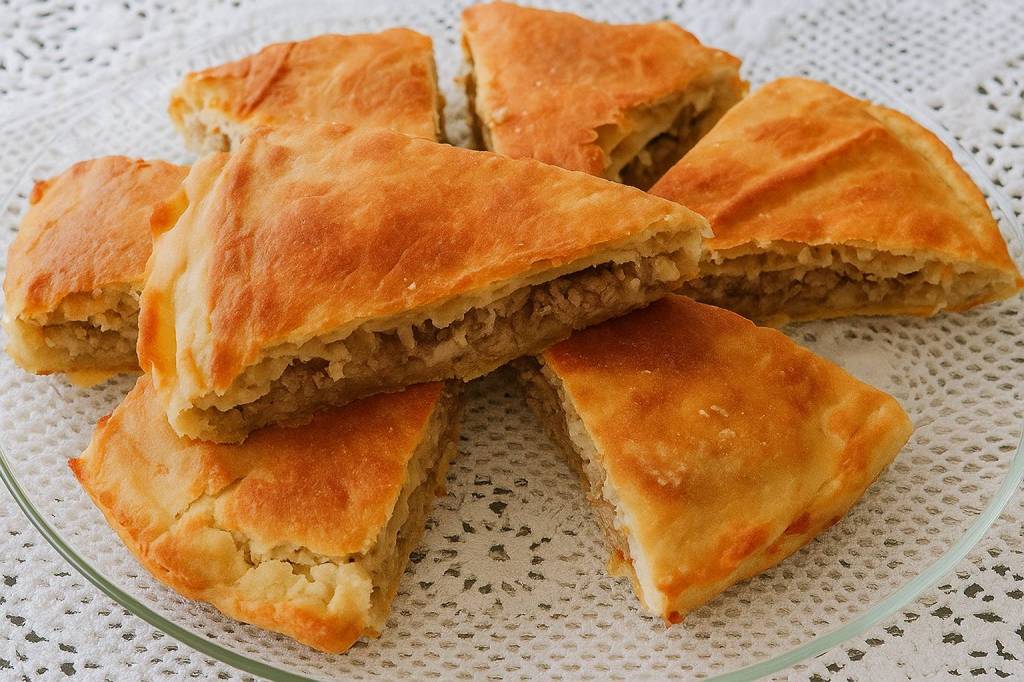
In Xanthi, a pie is never “just a pie.” It’s a craft, a story, and a warm memory passed from generation to generation.
The Xanthi meat pie, with its handmade phyllo and aromatic filling of leeks, minced meat, and spices, was always the star of festive and Sunday tables in Thrace.
Local women used to say: “If you don’t open the phyllo with your own hands, the pie won’t come to life!”
This recipe follows the authentic version from the villages of Genisea, Diomideia, and Magiko—simple ingredients, traditional techniques, and the unmistakable flavor of Thracian home cooking.
If you’re looking for a traditional Greek meat pie with handmade phyllo, this is the real deal.
Authentic Thracian Meat Pie (Kreatopita Xanthis)
INGREDIENTS – For 8 phyllo sheets (35 cm pan)
For the Homemade Phyllo
- 1 kg all-purpose flour
- 1 cup lukewarm water
- ½ cup olive oil
- 1 tsp salt
- 1 tbsp vinegar
- Optional: 1 egg
HOW TO MAKE THE PHYLLO
- Kneading
Make a well in the flour, add salt, olive oil, vinegar, and slowly add water. Knead until soft, smooth, and non-sticky. - Resting
Cover and let the dough rest for 30 minutes to “relax.” - Rolling the Phyllo
Cut into orange-sized balls and roll out first with a short rolling pin, then with a long one. Use corn flour (or cornstarch) to prevent sticking. - Layering
Brush each sheet lightly with olive oil.Place 3–4 sheets on the bottom, add the filling, then cover with 3–4 more sheets. Fold edges inward and score the top gently.
Filling – Xanthi Meat Pie
INGREDIENTS (35 cm pan)
- 500 g ground beef or lamb (or half-and-half)
- 2 large leeks, finely chopped
- 1 onion
- ½ cup olive oil or butter
- 2 eggs
- 1 cup medium-grain rice (or bulgur for the old-style version)
- Salt, pepper, a pinch of allspice & cumin
- 1 cup meat stock or water
- 1 egg for brushing
HOW TO MAKE THE FILLING
- Sautéing
Sauté onion and leeks until soft.Add the minced meat, cook thoroughly, then season with spices and add a splash of stock to “mellow” the mixture. - Binding
Add rice and let it simmer until it absorbs the liquid. Allow to cool slightly, then stir in the beaten eggs. - Assembling
Brush the pan with olive oil. Layer 3–4 phyllo sheets, add the filling, then cover with 3–4 more sheets. Seal the edges. - Baking
Brush the top with an egg wash. Bake at 180°C (356°F) for 50–60 minutes, until golden and crisp.
Extra Tips
- Crispier phyllo: lightly mist water between the layers.
- More elastic dough: add the optional egg to the phyllo.
- Richer flavor: use half beef, half lamb.
- Traditional aroma: a tiny pinch of cinnamon (optional).
- Better slicing: let the pie rest 10 minutes before cutting.
Drink Pairings
Red wines of Thrace:
- Mavroudi
- Muscat of Alexandroupolis
Greek reds: Xinomavro or Merlot
Lighter options: Vidiano or Moschofilero (white)
Nutritional Information (per slice, approx.)
Calories: ~420 kcal
Protein: 17–20 g
Carbs: 35–40 g
Fat: 20–24 g
Fiber: 2–3 g
Benefits: high protein sustained energy from rice vitamins A & K from leeks healthy fats from olive oil
FAQ – Frequently Asked Questions
- Can I make it without homemade phyllo?
Yes, use village-style phyllo for the closest texture.
- Can I replace the rice?
Use bulgur for a more traditional old-fashioned result.
- Can I prepare it the day before?
Yes—assemble, cover, and bake the next day.
- Does it taste good cold?
Absolutely. It’s one of those pies that set beautifully after a few hours.
- Can I make a fasting/vegan version?
Not the traditional one, but you can make a leek pie without meat and eggs.

 CookTheGreekWay